
Greenwich Arrest Records and Booking Reports
Greenwich booking reports track arrests made by the Greenwich Police Department in this Fairfield County town of about 63,000 residents. When someone is arrested in Greenwich, the police create a record that includes the person's name, the charges, and other key facts. These records are public under Connecticut law once the arrest is made. You can request copies through the Greenwich Police General Services Division, which handles all police records for the town.
Greenwich Quick Facts
Greenwich Police General Services Division
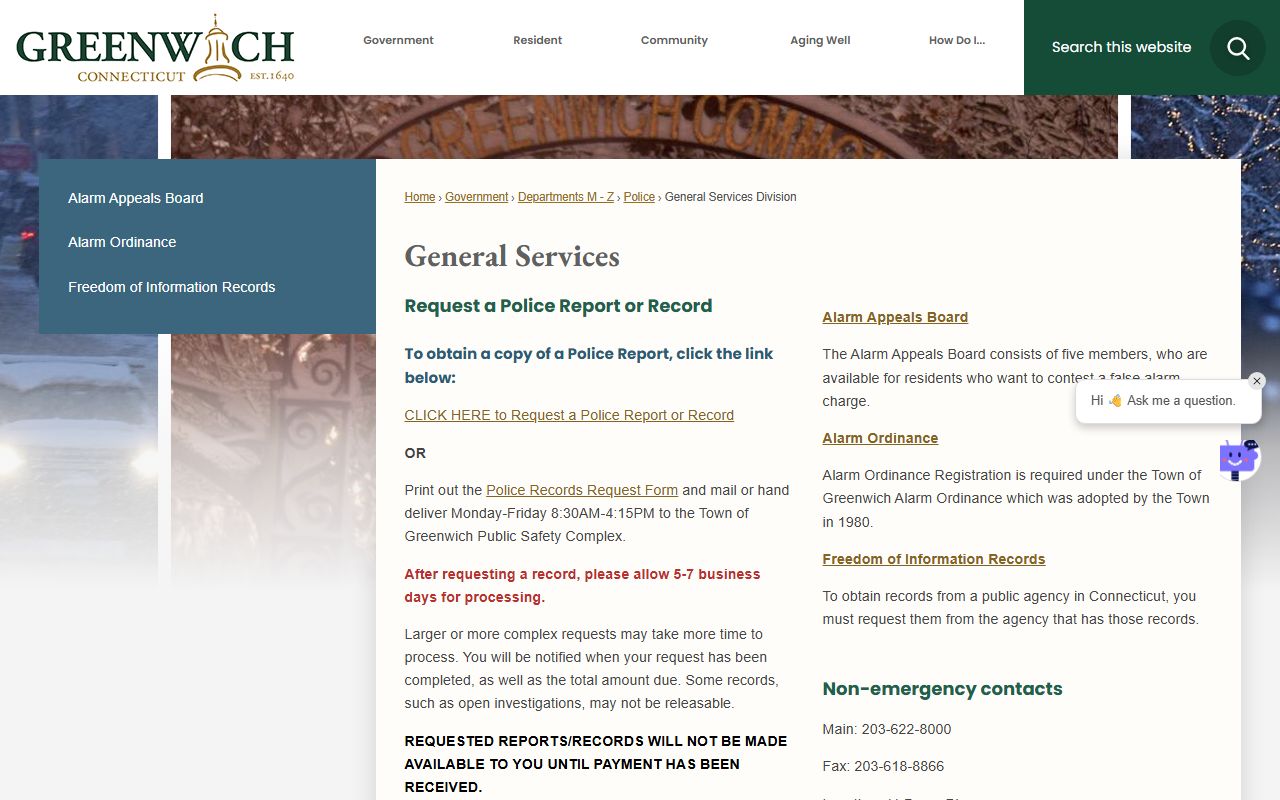
The General Services Division is the main contact for police records in Greenwich. This office handles requests for arrest reports, incident reports, accident reports, and other documents created by the police department. The division is open Monday through Friday from 8:30 AM to 4:15 PM. If you need help or have questions about a report, call 203-622-8004 any time.
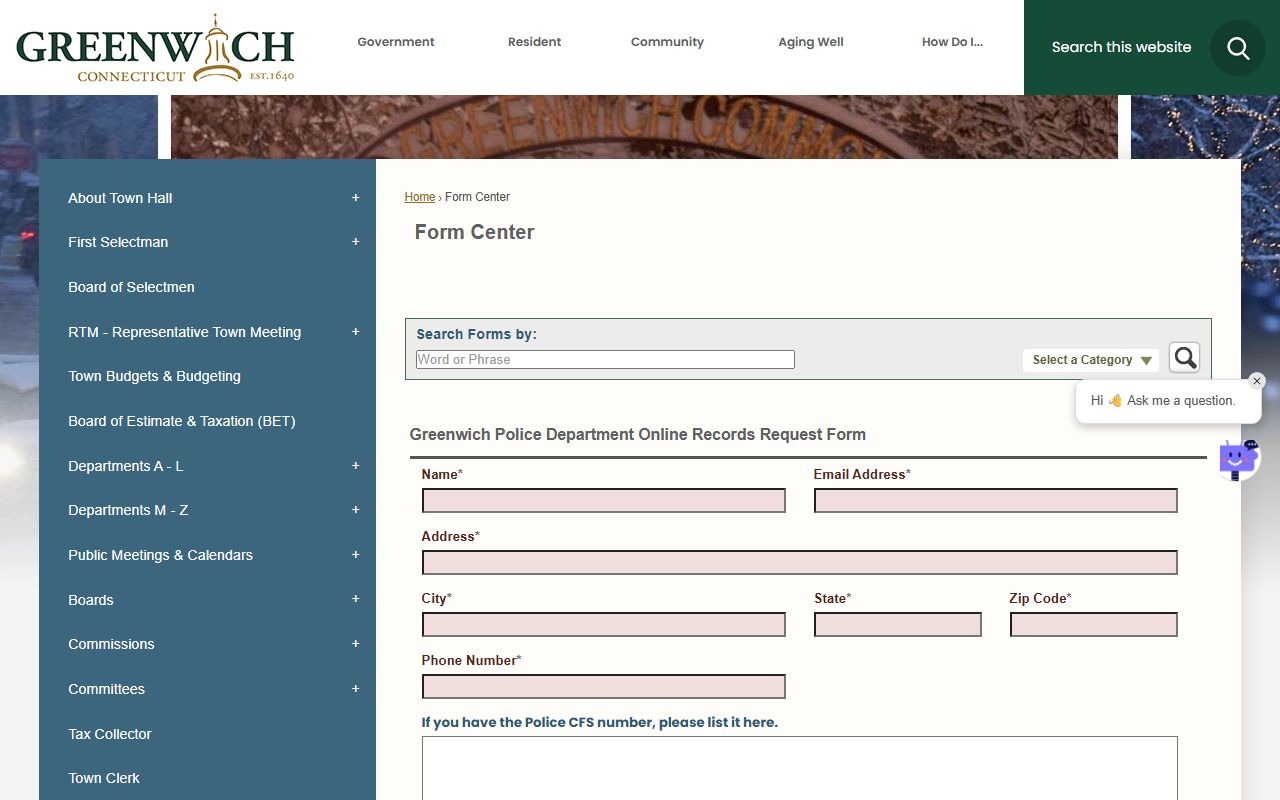
To request a record, you can use the online form at greenwichct.gov. The form asks for the case number and other details about the record you want. Case numbers in Greenwich start with a two-digit year followed by a set of numbers. For example, 20-12345 would be a case from 2020. If you do not know the case number, call the General Services Division and they can help you find it.
| Office | Greenwich Police General Services Division |
|---|---|
| Hours | Monday - Friday, 8:30 AM to 4:15 PM |
| Phone | (203) 622-8004 (24/7 for emergencies) |
| Online Form | greenwichct.gov |
Most police reports cost money to copy. The fee is usually $0.50 per page, which is standard across Connecticut. Some reports are longer than others. An arrest report may run several pages depending on the case. The General Services Division will tell you the cost when you make your request for records from Greenwich.
Some records may not be available right away. If a case is still active in court, the police may hold the report until the case ends. This is common when charges are pending. Once the case is done, the report becomes public under the Connecticut Freedom of Information Act. You can then get a copy from the General Services Division in Greenwich.
How to Request Arrest Records in Greenwich
To request an arrest record in Greenwich, you start by getting the case number. If you do not have it, call the police at 203-622-8004. They can look up the case by name or date. Once you have the case number, fill out the online records request form. The form is easy to use and guides you through what info you need to provide.
The form asks for your name, contact info, and details about the record you want. Be as specific as you can. Include the date of the arrest, the name of the person arrested, and the case number. The more info you give, the faster the police can find the right file. Submit the form and wait for a response. The police will tell you if the record is available and how much it will cost.
You can also visit the police station in person to request records. The General Services Division is open during business hours. Bring a valid ID and any info you have about the case. The staff can help you find the record and make copies on the spot if the report is available. This is often the fastest way to get arrest records from Greenwich.
If you prefer to call, dial 203-622-8004. The line is staffed 24/7. During business hours, you can speak with someone in the General Services Division about your records request. After hours, you can still call for help if you need to speak with an officer about a recent arrest in Greenwich.
Note: The police must respond to records requests within ten business days under Connecticut law.
Freedom of Information Act and Arrest Records
The Connecticut Freedom of Information Act makes arrest records public. This law applies to Greenwich and all other cities in the state. Under FOIA, anyone can ask to see arrest records. The police must give you access unless a specific rule says no. Most arrest records are open to the public once the person is booked.
Some records stay sealed. Juvenile records are confidential. Victims of sexual assault have their names protected. Records tied to ongoing investigations may be withheld until the case is done. Medical info and personal details may be redacted. These are the main limits on public access to booking reports in Greenwich.
If the Greenwich Police deny your request for records, they must give a reason. The denial must cite a specific law that allows them to withhold the records. If you think the denial was wrong, you can file a complaint with the Freedom of Information Commission. The complaint must be filed within 30 days. Contact the commission at portal.ct.gov/foi or call 860-566-5682.
The commission reviews complaints about denied records requests in Greenwich and across Connecticut. They investigate and decide if the city had a legal reason to say no. If the denial was wrong, the commission orders the records released. This is how the public can challenge a denial of access to arrest records in Greenwich.
Connecticut State Arrest Databases
People arrested in Greenwich may end up in state custody. Connecticut runs all jails and prisons at the state level. You can search for current inmates at ctinmateinfo.state.ct.us. This database shows everyone in state custody. You search by name, date of birth, or inmate number.
The inmate search gives you the person's current location, booking photo, charges, admission date, and status. It tells you if they are sentenced or waiting for trial. The database updates daily to keep info current for people arrested in Greenwich and across the state. Youthful offender records and ICE detainees do not appear in this search.
Court records are also online. The Connecticut Judicial Branch runs the criminal case lookup at jud.ct.gov. This system lets you search for convictions, pending cases, arrest warrants, and daily dockets. You can search by name or by docket number. The system covers all courts in Connecticut, including cases from Greenwich.
Conviction records stay on the court website for up to ten years after sentencing. Some records come off sooner based on state rules. The site does not show juvenile cases, youthful offender cases, or minor infractions. What you see are the more serious criminal cases that went through the court system after arrests in Greenwich.
State Police Criminal Background Checks
For an official criminal history record, you go to the State Police Bureau of Identification. This is the state agency that keeps records for everyone arrested in Connecticut, including people arrested in Greenwich. The background check is more complete than searching online databases on your own.
Getting a background check requires fingerprints. You book an appointment at the State Police office in Middletown at 1111 Country Club Road. You need a valid photo ID and payment. A state criminal history check costs $75. Fingerprinting costs $15. A federal background check adds $13.25 more. All fees must be paid in check, money order, or exact cash.
Call 860-685-8480 to schedule an appointment. You can also book online through the state website. Walk-ins are not accepted. You must schedule ahead. Once you complete the appointment and pay the fees, the background check is processed. Results come back in a few weeks for people with arrests in Greenwich or elsewhere in Connecticut.
This is the official way to get a criminal history record. Employers and licensing boards use this system. The report shows all arrests and convictions on file with the State Police. It is considered the most accurate source for criminal history in Greenwich and across the state.
Erasing Arrest Records in Connecticut
Some arrest records in Greenwich can be erased from public view. Connecticut has an automatic erasure law. Records that meet certain conditions are erased without you having to file a request. Erasure does not delete the record. It just hides it from public searches. Police and courts can still see it, but employers and landlords cannot.
Arrests that did not lead to a conviction are erased 13 months after the case ends. If charges were dismissed or dropped with a nolle, the record erases 13 months later. If you were found not guilty, the record erases right away. This applies to arrests in Greenwich and everywhere else in Connecticut. The erasure happens without you asking for it.
Convictions can also be erased after a waiting period. Misdemeanor convictions erase after seven years. Some felony convictions erase after ten years. The law lists which crimes qualify for automatic erasure. You can find the list at the Clean Slate Program page. This program explains how erasure works for arrests in Greenwich and other cities.
If your arrest does not qualify for automatic erasure, you can file a hearing request. The court will review your case and decide if erasure is appropriate. This gives you a way to clear records that do not meet the automatic rules. It takes more work, but it is an option for people with old arrests in Greenwich who want a clean slate.
Legal Help for Arrest Cases in Greenwich
If you were arrested in Greenwich, you may need a lawyer. Public defenders help people who cannot afford a private attorney. You apply for a public defender at your first court appearance. The judge decides if you qualify based on income. If you do, a public defender is assigned at no cost to handle your case.
Legal aid groups also serve the area. Statewide Legal Services of Connecticut offers free legal help to low-income residents. Call 1-800-453-3320 to ask about services. The Connecticut Bar Association runs a lawyer referral service at 1-860-223-4400. They connect you with a private attorney who offers a first meeting at a reduced cost.
The Connecticut Judicial Branch website has self-help guides for people handling their own cases. These guides cover topics like arraignments, filing motions, and other court steps. You can find forms and instructions online. This resource is helpful if you choose to represent yourself after an arrest in Greenwich.
The Fairfield County Bar Association also serves the Greenwich area. They have referral services and legal aid programs. You can find contact info on their website or by calling their main line. Many local attorneys offer a first meeting at a low cost to discuss your case after an arrest in Greenwich.
What Happens After an Arrest in Greenwich
After an arrest in Greenwich, the person is booked at the police station. This means their name, photo, and fingerprints go into the system. They are then held or released on bond. The bond amount is set based on the charge and the person's criminal history. Some people are released on a promise to appear in court.
The first court date is the arraignment. At this hearing, the judge reads the charges and asks how the person pleads. The judge also reviews the bond and may change it. If you cannot afford a lawyer, you apply for a public defender at this hearing. The judge decides if you qualify based on your income.
If the case moves forward, there may be more hearings. Some cases go to trial. Others are resolved through a plea deal. The outcome of the case appears in court records. You can search for the case at jud.ct.gov to see what happened after the arrest in Greenwich.
Convictions lead to sentencing. The judge may order jail time, probation, fines, or other penalties. The sentence becomes part of the court record. If the case was dismissed or the person was found not guilty, that outcome also shows up in the court records for Greenwich. Either way, the final result is public info.
Common Charges in Greenwich Arrest Records
Greenwich sees a mix of property crimes, motor vehicle offenses, and some violent crimes. Larceny is a common charge. This covers theft of property. The degree depends on the value of what was taken. Motor vehicle violations are also common. These include DUI, operating with a suspended license, and reckless driving.
Drug charges appear in some arrest records. Possession of a controlled substance and use of drug paraphernalia are typical charges. Assault and threatening charges also show up. These range from minor incidents to more serious cases. Each charge has a statute number that tells you the exact law that applies to the arrest in Greenwich.
Domestic incidents lead to some arrests. The police respond to calls about family disputes. These may result in charges like assault, threatening, or breach of peace. The arrest record will show the charge but may not give full details about what happened. For that, you need the full police report from the General Services Division in Greenwich.
Fairfield County Booking Reports
Greenwich is part of Fairfield County. Each city and town in the county has its own police department and arrest records. For a broader view of arrest records across the county, see the Fairfield County page. That page links to all local departments, county resources, and state systems that handle booking reports and criminal records in the county.